> ## Documentation Index
> Fetch the complete documentation index at: https://docs.celo.org/llms.txt
> Use this file to discover all available pages before exploring further.
# Proof of Stake
export const YouTube = ({videoId}) => {
return
;
};
Overview of Celo's proof-of-stake algorithm, mechanisms, and implementation.
This page describes the historical Celo Layer 1 blockchain. It is useful for understanding Celo’s history, but does not reflect the current state of the network. As of block height 31,056,500 (March 26, 2025, 3:00 AM UTC), Celo has transitioned to an Ethereum Layer 2.
***
## Mastering the Art of Validating
## Validator Types
Celo uses a Byzantine Fault Tolerant [consensus protocol](/legacy/protocol/consensus/index) to agree on new blocks to append to the blockchain. The instances of the Celo software that participate in this consensus protocol are known as **validators**. More accurately, they are **active validators** or **elected validators**, to distinguish them from **registered validators** which are configured to participate but are not actively selected.
## Proof-of-Stake
Celo's proof-of-stake mechanism is the set of processes that determine which nodes become active validators and how incentives are arranged to secure the network.
## Active Validators
The first set of active validators are determined in the genesis block. Thereafter at the end of every epoch, a fixed number of blocks fixed at network creation time, an election is run that may lead to validators being added or removed.
## Validator Elections
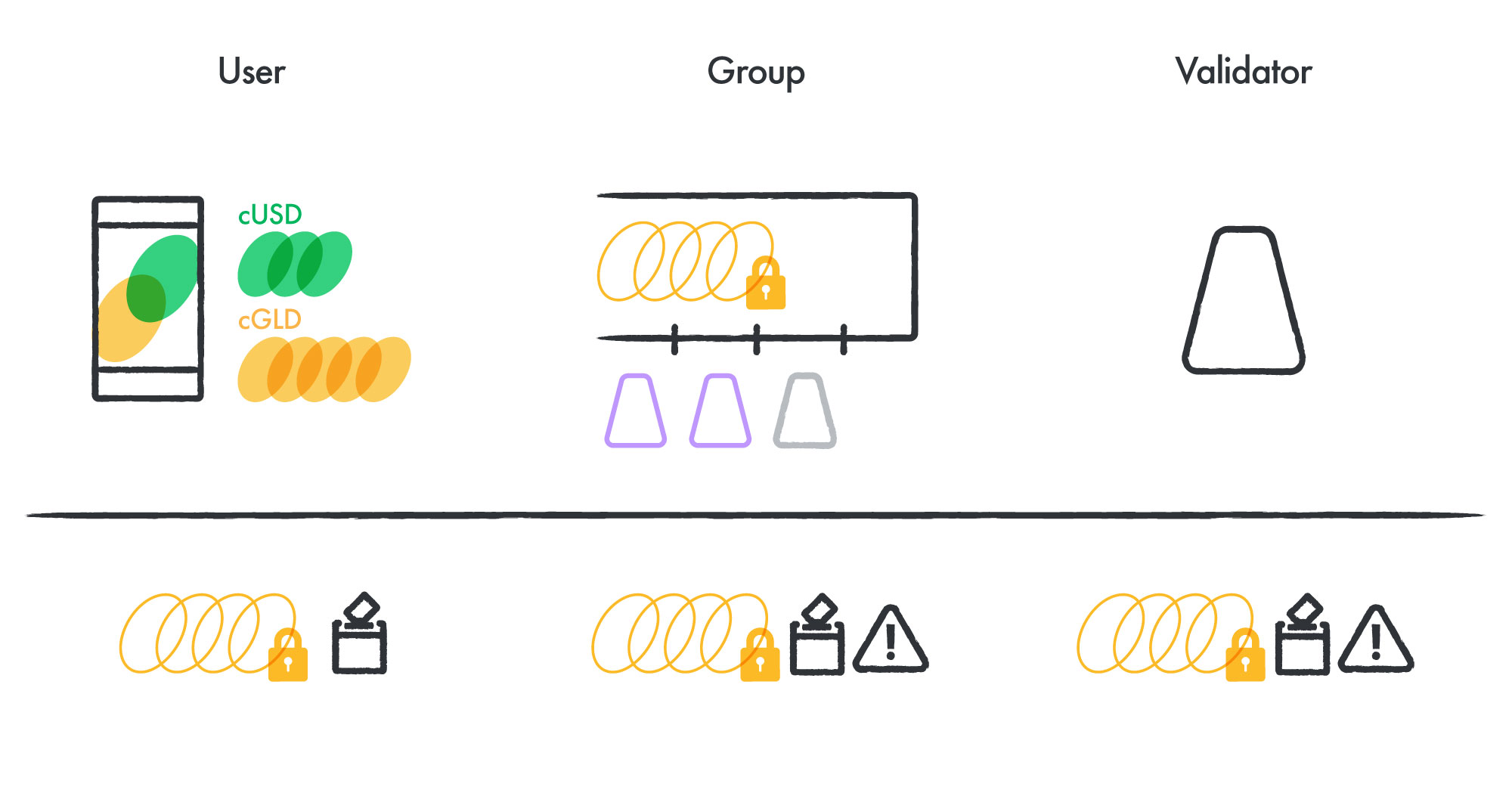
In Celo's [Validator Elections](/legacy/protocol/pos/validator-elections), holders of the native asset, CELO, may participate and earn rewards for doing so. Accounts do not make votes for validators directly, but instead vote for [validator groups](/legacy/protocol/pos/validator-groups).
Before they can vote, holders of CELO move balances into the [Locked Gold](/legacy/protocol/pos/locked-gold) smart contract. Locked Gold can be used concurrently for: placing votes in Validator Elections, maintaining a stake to satisfy the requirements of registering as a validator or validator group, and also voting in on-chain [Governance](/home/protocol/governance/overview) proposals. This means that validators and groups can vote and earn rewards with their stake.
**note**
Unlike in other proof-of-stake systems, holding Locked Gold or voting for a group does not put that amount 'at risk' from slashing due to the behavior of validators or validator groups. Only the stake put up by a validator or group may be slashed.
## Implementation
Most of Celo's proof-of-stake mechanism is implemented as smart contracts, and as such can be changed through Celo's on-chain [Governance](/home/protocol/governance/overview) process.
* [`Accounts.sol`](https://github.com/celo-org/celo-monorepo/blob/master/packages/protocol/contracts/common/Accounts.sol) manages key delegation and metadata for all accounts including Validators, Groups and Locked Gold holders.
* [`LockedGold.sol`](https://github.com/celo-org/celo-monorepo/blob/master/packages/protocol/contracts/governance/LockedGold.sol) manages the lifecycle of Locked Gold.
* `Validators.sol` handles registration, deregistration, staking, key management and epoch rewards for validators and validator groups, as well as routines to manage the members of groups.
* [`Election.sol`](https://github.com/celo-org/celo-monorepo/blob/master/packages/protocol/contracts/governance/Election.sol) manages Locked Gold voting and epoch rewards and runs Validator Elections.
In Celo blockchain:
* [`consensus/istanbul/backend/backend.go`](https://github.com/celo-org/celo-blockchain/blob/master/consensus/istanbul/backend/backend.go) performs validator elections in the last block of the epoch and calculates the new [validator set diff](/legacy/protocol/consensus/validator-set-differences).
* [`consensus/istanbul/backend/pos.go`](https://github.com/celo-org/celo-blockchain/blob/master/consensus/istanbul/backend/pos.go) is called in the last block of the epoch to process validator uptime scores and make epoch rewards.